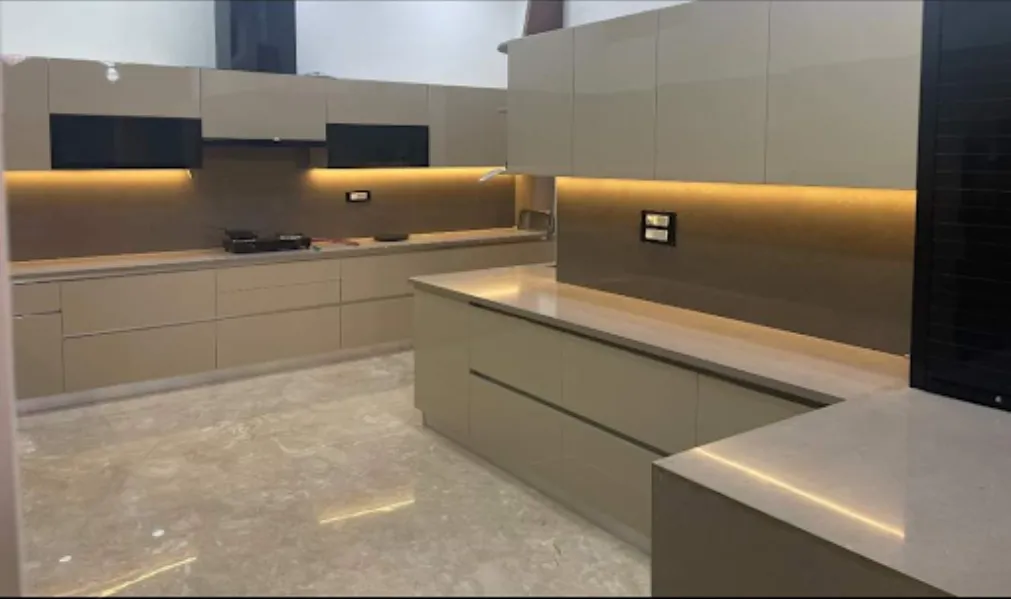
Modern apartments often have less kitchen space than homeowners expect, yet the kitchen still needs to accommodate cooking appliances, groceries, utensils, cookware, cleaning supplies, and everyday movement. A professional Modular kitchen manufacturer approaches this challenge by planning the available space around actual household requirements rather than simply filling walls with cabinets.
For homeowners in Punawale, Maharashtra, this type of planning can be particularly useful in apartments where kitchen dimensions, utility areas, windows, plumbing points, and electrical connections are already fixed.
Good Kitchen Planning Begins With Measurements
A modular kitchen should ideally be designed after accurate site measurements. Even small differences in wall dimensions can affect shutters, countertops, appliances, and corner units.
Measurements generally need to account for:
- Floor-to-ceiling height
- Countertop dimensions
- Door positions
- Windows and ventilation
- Electrical points
- Plumbing connections
- Gas pipeline location
- Refrigerator dimensions
- Chimney placement
- Utility access
A modular kitchen manufacturer can use these details to determine which cabinet configuration makes practical sense.
Storage Should Match Everyday Habits
More cabinets do not automatically create a better kitchen. Storage becomes useful when frequently used items are easy to reach.
Daily-use plates and bowls may need accessible drawers. Heavy pots can be placed in deeper lower cabinets. Spices and cooking ingredients should remain close to the preparation area, while less frequently used appliances can occupy higher cabinets.
This user-focused approach prevents a common problem in kitchen interiors where storage looks impressive but becomes inconvenient after regular use begins.
Corners Need Careful Attention
Corners can become wasted areas when cabinetry is planned without considering accessibility. Depending on dimensions and budget, suitable corner mechanisms can help homeowners make better use of these spaces.
However, specialised hardware should not be selected simply because it looks sophisticated. Its dimensions, accessibility, maintenance needs, and actual usefulness should be considered before installation.
Materials Should Suit Kitchen Conditions
Kitchen cabinets experience heat, moisture, food spills, oil, repeated opening, and regular cleaning. Material selection therefore affects long-term usability.
Homeowners should understand the difference between the cabinet structure, shutter finish, countertop, hardware, and accessories rather than treating the entire kitchen as one material.
For example, an attractive shutter finish cannot compensate for poorly selected internal materials or weak hardware.
Workflow Matters as Much as Appearance
An efficient kitchen allows comfortable movement between important activity zones such as food storage, preparation, cooking, and washing.
The exact arrangement depends on the kitchen shape. A straight kitchen requires different planning from an L-shaped, parallel, or U-shaped layout.
Adequate passage space is equally important. Installing oversized cabinets or counters in a compact kitchen can make movement unnecessarily difficult.
Think Beyond the Installation Day
A kitchen will be used thousands of times over its lifespan. Before finalising a design, homeowners should consider how easily surfaces can be cleaned, whether drawers open without obstruction, whether appliances can be removed for servicing, and whether plumbing remains accessible.
Families may also want to consider how their storage requirements could change over time.
A thoughtfully designed modular kitchen is therefore not defined by the number of cabinets or decorative finishes alone. It combines accurate dimensions, suitable materials, accessible storage, comfortable movement, and practical maintenance.
For Punawale homeowners evaluating kitchen interiors, understanding these fundamentals makes discussions with a modular kitchen manufacturer more productive. Providers such as Veer Modular Kitchen can then develop the design around the property's dimensions and the household's actual requirements rather than relying on a standard configuration.
Keywords