A storage bed only improves a bedroom when its compartments match the items you store and the room leaves enough space to open, clean and repair them. By the end, you will be able to compare lift-up and drawer designs, calculate usable capacity, check safety and hardware, and prepare a design brief that fits your room.
Key takeaways
- Use front-access storage for bedding and daily essentials.
- Reserve deep compartments for luggage, blankets and seasonal clothing.
- Measure drawer clearance, lift access, walking space and cleaning gaps.
- Compare lifting hardware, drawer runners, materials and safety features before ordering.
Match Each Storage Configuration to the Items You Reach For
Bedding and everyday items need front access; seasonal clothing and luggage suit deeper storage that you open less often. The best configuration depends on how often you reach in, not the advertised capacity.
| Option | Best for | Main limitation |
|---|---|---|
| Lift-up hydraulic storage | Seasonal clothing, spare bedding and luggage | You must raise the mattress and platform, so daily access becomes inconvenient; the mechanism must be rated for the mattress, platform and stored load |
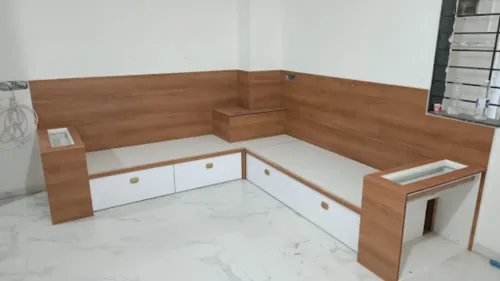
| Drawer storage | Frequently used bedding, folded clothing and everyday items | Each drawer needs room to extend fully, plus standing space to pull it out safely |
| Side compartments | Bedding, shoes and items needed from one side of the bed | Side access fails if a wall, wardrobe or bedside table blocks the opening |
| Headboard shelving | Books, glasses, chargers and small everyday items | Deep shelves become difficult to reach and can turn into clutter |
| Under-bed boxes | Shoes, spare linens and low-frequency items | Boxes are less convenient than drawers and require lifting or sliding each container out |
Choose drawer storage when you change sheets often or store clothes by category. Choose lift-up hydraulic storage for bulky items, but avoid one deep cavity if you will constantly unload the mattress to reach the bottom.
- Put books and chargers in headboard shelving.
- Put frequently used bedding in front-access drawers or side compartments.
- Put luggage and seasonal clothing in lift-up storage or under-bed boxes.
- Treat volume behind frame rails, partitions and drawer hardware as unavailable space; usable capacity matters more than the quoted total.
Measure the Room for Access, Cleaning and Daily Movement
Measure the actual mattress, then add the bed’s frame, upholstery and trim to find the mattress size and overall bed footprint. A nominal queen is about 60 by 80 inches and a king about 76 by 80 inches, but manufacturing tolerances and edge details change the space required.
Mark the proposed footprint on the floor with masking tape and check:
- Leave drawer extension clearance equal to the fully opened drawer, plus standing space to pull it out and bend safely.
- Test lift-up access by allowing the platform and mattress to rise without striking a ceiling fixture, wall, bedside table or wardrobe.
- Keep walking paths wide enough for normal movement, including the route between the bed, room entrance and storage.
- Open door swings and wardrobe doors fully; a bed that fits with doors closed can block them in daily use.
- Check windows and wardrobes for handles, curtains, radiators and panels that could collide with the frame or lifted platform.
A shallow drawer that opens completely is more useful than a deep drawer blocked by a wall or wardrobe. Count the space needed to remove the drawer, not only the storage box inside it; runners, frame rails and partitions reduce usable capacity.
Check cleaning access before ordering. Leave a route for a vacuum head or mop along exposed sides, and confirm that lift-up access does not require moving the mattress every time. If the room cannot provide front clearance, choose side-access compartments or lift-up access rather than forcing drawers into a blocked layout.
Compare Lifting Hardware, Drawers, Materials and Safety
A storage bed remains usable and safe only when its hardware, panels and connections are designed for the loaded bed, not an empty showroom model.
| Option | Construction and hardware | What to verify |
|---|---|---|
| Lift-up platform | Hydraulic gas lifts and counterbalances, hinges and a rigid platform | Get a weight rating for mattress, platform, bedding and contents. Hardware sized for an empty platform may not hold it open; oversized lifts can make closing dangerous. |
| Drawer storage | Full-extension drawer runners, properly fixed boxes and handles | Check the runner rating for the loaded drawer, including books or linens. Follow the manufacturer’s screw spacing and installation requirements. |
| Bed carcass | Adequate board thickness, sealed edges and load-bearing construction | Thin panels can flex, strip screws or sag. Sealed edges resist swelling when moisture reaches particleboard or fiberboard. |
| Tall attached storage | Anchored connections and secure load-bearing construction | A headboard tower or shelving module must be anchored as specified; the bed’s low base does not prevent a tall unit from tipping. |
Ask for the following before ordering:
- The tested hardware capacity and the maximum permitted stored load.
- A stated board thickness for the platform, side rails and drawer boxes.
- Drawer runner load ratings measured with the drawer extended, not empty.
- A stop or support that prevents the lift-up platform from dropping unexpectedly.
- Sealed or edge-banded cut-outs, plus raised interiors if damp floors or wet laundry are concerns.
Never store damp clothing inside enclosed compartments. Moisture can cause swelling, delamination and lost screw-holding strength long before the damage is visible.
Protect Stored Items and Decide Whether a Storage Bed Fits Your Routine
Keep every item completely dry before it enters the bed cavity. Poor ventilation and indoor humidity above 60% encourage musty odours and mould; aim for 30% to 50% relative humidity and dry damp materials within 24–48 hours.
- Use sealed containers and dry fabrics for seasonal clothing, spare quilts and documents. Do not compress damp textiles into plastic bags.
- Apply deep-compartment organisation: place rarely used luggage at the back, then label each container so reaching one item does not require emptying the cavity.
- Keep a small air gap around stored contents where the design allows it. Inspect for condensation, insects and damaged hinges during routine cleaning.
- Preserve robot vacuum and standard mop access beneath and around the bed. A storage base that blocks cleaning turns dust into a moisture-retaining layer.
| Storage option | Choose it when | Another solution is better when |
|---|---|---|
| Storage bed | You want hidden capacity in the same footprint and can maintain the lifting or drawer mechanism | You need daily access without moving bedding or opening heavy hardware |
| Freestanding wardrobe or dresser | You reach clothing every day and need standing-height shelves and hanging space | Floor area is tight and concealed, occasional-use storage matters more |
| Stackable boxes or a closet shelf | You need labelled seasonal storage that can be removed and cleaned separately | Loose containers would clutter the room or reduce walking clearance |
A storage bed is the wrong fit if opening it feels like a chore, the cavity is hard to clean, or you regularly store wet gear. Choose accessible furniture instead; convenience protects both your routine and your belongings.
Turn a Bedroom Design Consultation into a Buildable Plan
Before paying a deposit, require a signed, buildable specification rather than a mood-board image. It must show the actual mattress size, overall footprint, clearance, storage layout, and a dimensioned drawing and internal measurements for every compartment.
- Ask for the opening direction and hardware specification. For a lift-up platform, the mechanism rating must cover the mattress, platform, bedding and stored contents; oversized or under-rated struts create unsafe closing or collapse risks.
- Request a material sample showing the board, laminate, edge banding, upholstery and colour in daylight. Confirm the platform construction against your mattress warranty because slat gaps, solid decks and ventilated panels have different requirements.
- Obtain the installation scope in writing: delivery, assembly, floor levelling, wall anchoring for a tall headboard or storage tower, removal of packaging, and final adjustment. Ask whether threaded inserts, cross-dowels or other serviceable connectors are used.
- Mark electrical outlets, bedside tables, reading lights and charging points on the drawing before fabrication. A headboard can block sockets, while a drawer or lift mechanism can make a planned outlet inaccessible.
- Clarify warranty and repair responsibility, including who replaces failed struts, runners and damaged panels, response time, exclusions and whether parts remain available.
Nilkanth Modular Kitchen Interior - 9766310041 can use these questions during a bedroom consultation, but you should keep the approved drawings, samples, load ratings and written responsibilities with your order. Verbal promises are difficult to verify after installation.
Related product
 | Modular Bed Nilkanth Modular Kitchen Provides you high quality Modular Brd Set. A bedroom is the most important part of any house. View product → |
Frequently asked questions
Which storage configuration suits items I use every day?
Choose front-access drawers or compartments for bedding, clothing and other items you reach for frequently.
Where should I store luggage and seasonal clothing?
Use deeper under-bed storage for luggage, spare blankets and seasonal clothing that you open less often.
What should I measure before choosing a modular storage bed?
Measure the room, walking routes, drawer or lift clearance, cleaning access and nearby furniture positions.
What should I compare in modular bed hardware?
Compare lift-assist mechanisms, drawer runners, load capacity, locking or closing features, ventilation and child-safety details.
How can I protect items stored under a bed?
Use sealed or lined compartments, keep fabrics in breathable covers, and check the storage area for dust and moisture.