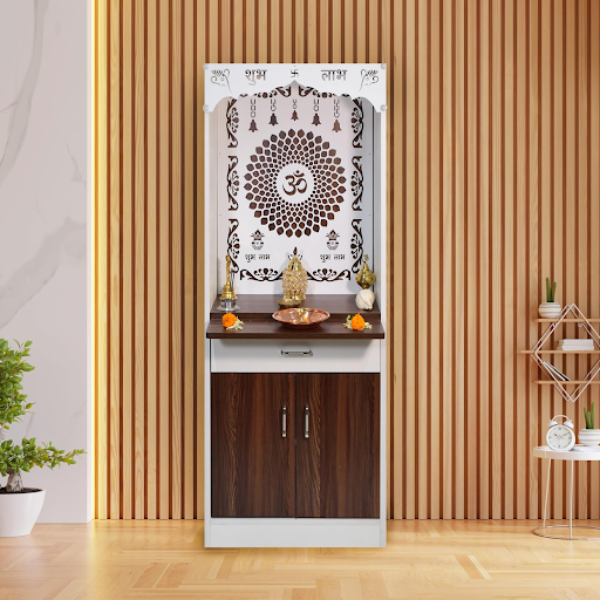
A home Mandir Unit often needs to balance spiritual significance with the practical limitations of modern apartment interiors. The challenge is not simply finding an empty corner. Placement, proportions, storage, lighting, ventilation, maintenance, and surrounding furniture can all influence whether the unit feels integrated into the home.
For families in Ravet, Maharashtra, customised mandir planning can be useful when a standard ready-made unit does not suit the available dimensions.
Select the Location Carefully
The appropriate location depends on household preferences, available space, and the layout of the property.
Some families prefer a dedicated prayer room, while others integrate the mandir into a living room, dining area, passage, or suitable niche.
Whatever location is selected, it should ideally remain accessible without obstructing normal circulation.
Doors, drawers, nearby furniture, and walking paths should all be considered.
Determine the Required Storage
Prayer spaces often need storage for incense, lamps, prayer books, matches, cloth, flowers, and other items.
A few well-positioned drawers or cabinets can keep these supplies organised without making the mandir visually heavy.
Storage should be planned around actual requirements. An oversized base cabinet may dominate a compact room, while insufficient storage can leave everyday items exposed.
Consider Lighting at the Planning Stage
Soft lighting can highlight the mandir and provide comfortable illumination for daily use.
Electrical points should ideally be planned before manufacturing so visible wiring can be minimised.
If decorative lighting is included, homeowners should ensure that switches and components remain accessible for future maintenance.
Lighting should complement the unit rather than overwhelm it.
Material Selection Should Account for Maintenance
Intricate decorative surfaces can be visually appealing but may require more frequent cleaning.
The amount of carving, grooves, open shelving, and decorative detailing should therefore reflect how much maintenance the household is comfortable performing.
Smooth surfaces may suit homeowners who prefer simpler cleaning, while detailed traditional designs may appeal to families who prioritise ornamentation.
Proportion Is Important
A mandir should feel significant without appearing disproportionate to the room.
In compact apartments, a wall-mounted or vertically oriented unit may conserve floor space. Larger homes may accommodate a broader floor-standing configuration with more elaborate detailing.
Measurements should account for skirting, switches, adjacent doors, furniture, and ceiling features.
Coordinate the Design With the Interior
A contemporary home does not necessarily require an ultra-modern mandir, nor does a traditional unit need to look disconnected from modern furniture.
Design elements can bridge the two styles through complementary finishes, controlled ornamentation, suitable lighting, and balanced proportions.
The objective is to give the prayer area its own identity while maintaining visual continuity with the room.
Think About Everyday Use
Before approving a design, consider the daily routine around the unit.
Can required items be reached easily? Is there enough space in front? Are storage drawers convenient? Can surfaces be cleaned without difficulty? Are electrical points safely positioned?
These practical questions often reveal issues that are not obvious in a design rendering.
For Ravet homeowners, a customised Mandir Unit can provide a meaningful prayer area without disrupting the functionality of the surrounding interior. Veer Modular Kitchen can incorporate such furniture into broader interior planning where dimensions and finishes need to coordinate with nearby units.
Successful mandir design comes from respecting both the purpose of the space and the realities of the home around it.
Keywords