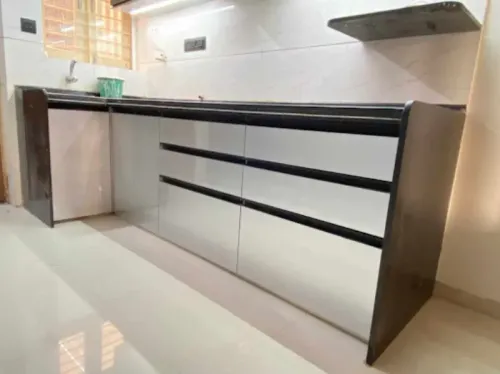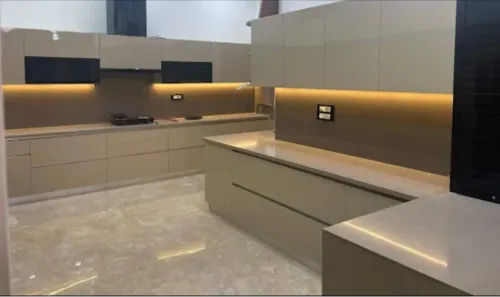
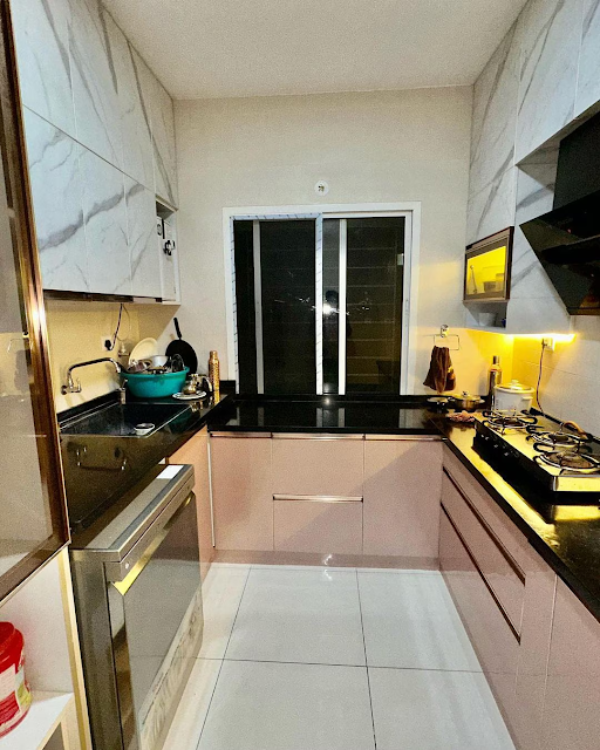
A visually impressive Modular Kitchen is useful only when it can handle the realities of everyday cooking. Heat, oil, water, heavy cookware, groceries, multiple appliances, and frequent cleaning place demands on kitchen materials and layouts that photographs alone cannot reveal.
For homeowners in Thergaon, Maharashtra, comparing modular kitchen options should therefore begin with functionality rather than decorative finishes.
Layout Comes Before Colour Selection
The kitchen layout determines how comfortably users can move between preparation, cooking, washing, and storage areas.
Common layouts include straight, L-shaped, parallel, and U-shaped kitchens.
The appropriate configuration depends on:
- Room dimensions
- Door locations
- Windows
- Utility access
- Plumbing
- Gas connection
- Appliance dimensions
- Number of regular users
Changing the finish cannot correct a fundamentally inconvenient layout.
Counter Space Needs Protection From Clutter
Modern kitchens contain multiple appliances, including mixers, microwaves, water purifiers, coffee machines, air fryers, and other equipment.
If every appliance occupies the main counter, preparation space can disappear quickly.
During planning, decide which appliances remain permanently accessible and which can be stored. Electrical sockets should then be positioned accordingly.
Storage Must Support Indian Cookware
Large pressure cookers, kadais, pans, containers, plates, spice boxes, and bulk groceries require varied storage dimensions.
Deep drawers can accommodate heavier cookware, while smaller drawers can organise cutlery and tools. Tall storage may be useful for selected groceries where dimensions permit.
The key is to avoid dividing storage into arbitrary sections that do not match actual items.
Ventilation Deserves Attention
Cooking can produce heat, steam, smoke, and oil particles.
Natural ventilation and an appropriately planned chimney can help manage the kitchen environment. Chimney placement should be coordinated with the hob and upper cabinetry from the beginning.
Duct routing, electrical provision, and maintenance access also need consideration.
Materials Should Be Compared as a System
Homeowners sometimes compare kitchens only by shutter finish.
A complete modular kitchen includes the cabinet structure, shutters, countertop, hardware, accessories, edge finishing, and installation quality.
Ask what material is being specified for each component and why it suits that application.
Moisture-prone areas, particularly around the sink, deserve additional attention.
Hardware Can Influence Long-Term Experience
Drawers and shutters may be opened many times each day.
Hinges, channels, lifting mechanisms, handles, and other moving components therefore play an important role in everyday usability.
Quality should be assessed according to expected use rather than merely choosing the largest number of accessories.
Compare Quotations Carefully
Two quotations that appear to describe similar kitchens may include very different materials, hardware, accessories, finishes, and scope.
Before comparing prices, ensure both quotations cover equivalent specifications.
Important questions include whether appliances are included, what countertop is specified, which hardware is used, and whether electrical, plumbing, civil, or painting work forms part of the scope.
For Thergaon homeowners evaluating a Modular Kitchen, these details provide a more meaningful basis for comparison than appearance alone.
A provider such as Veer Modular Kitchen can develop customised configurations based on measurements and household needs. The homeowner's role is to examine how the proposed kitchen will function during ordinary cooking, cleaning, storage, and maintenance. That practical evaluation is what separates a kitchen that merely looks organised from one that remains convenient after years of regular use.
Keywords